
British Defence Keeps Scoring Own-Goals
Could we stop, please?

It can be hard being a patriotic British defence specialist these days. The UK seems addicted to scoring stupid own-goals on national security. Let’s look at three that we’ve shot into the back of our own net in the recent weeks.1
The Defence Investment Plan
To start - the long-delayed Defence Investment Plan. This document, which was originally supposed to come out in September last year (!) was finally released last week after the resignation of two leading ministers and the eventual abdication of the Prime Minister himself. Despite the political drama, it pleased nobody. The money wasn’t enough for the MOD, yet far more than the Treasury wanted to pay out, and a chunk of it – around £4.7bn – is still unfunded and will have to be scraped off from yet further cuts. On top of that, despite the long wait, the final document was obviously rushed – the numbers didn’t properly add up, and on top of that it was appallingly written – defence jargon abounded to the detriment of clarity.2
There has been a deluge of commentary deep-diving into the Defence Investment Plan. Honestly, I don’t have much to add to the prevailing consensus at this stage. There were some welcome investments noted – air defence particularly got a much-needed boost across the board – but still so much detail was left out. Resilience was name-dropped as a buzzword but there was almost no substance to any of the ‘resilience’ measures proposed. The supposed ‘top priorities’ essentially encompassed all of Defence activity, so were useless. Any projects announced for beyond 2030 are unfunded so not worth getting too excited about as there is little to no heft behind them. We are still going on about having ‘up to 12’ attack submarines, unchanged from the Strategic Defence Review (I’ll bet you a tenner that we don’t get 12). In essence, very little has changed or been decided upon since the Strategic Defence Review, and many of the stipulations required in that Review - and officially accepted by the Government - remain un-financed.
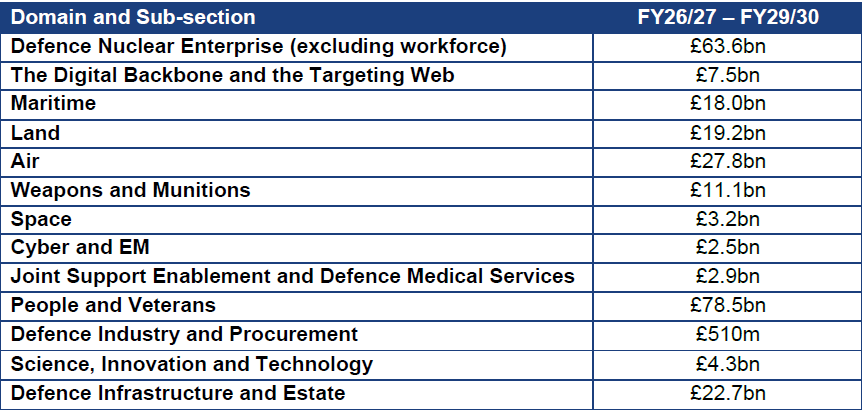
What is clear from the DIP is what was already known - nuclear is eating up the majority of the capital budget and will continue to rise as a proportion of MOD spending, with reduced money for anything else.3
In all, a predictable disappointment, and one that could have been avoided if Starmer had gotten a grip of his ministers early. So much for it being a major priority for his government, though at least it now exists in some form. We will see if the new Prime Minister – almost certainly Andy Burnham – proves any better on defence than Starmer has.
The DSRB
The Defence, Security and Resilience Bank has officially been announced with national backing, with Canada, Albania, Belgium, Greece, Latvia, Luxembourg, Romania, Türkiye and Ukraine as members. Canada is very much the leader, and the DSRB will be likely be headquartered there. The DSRB as a defence-focused multilateral lending institution should enable low-cost, long-term financing for defence and security initiatives across its member states.
Still a long way to go, but overall a win for NATO – and an utterly avoidable screw-up by the UK.
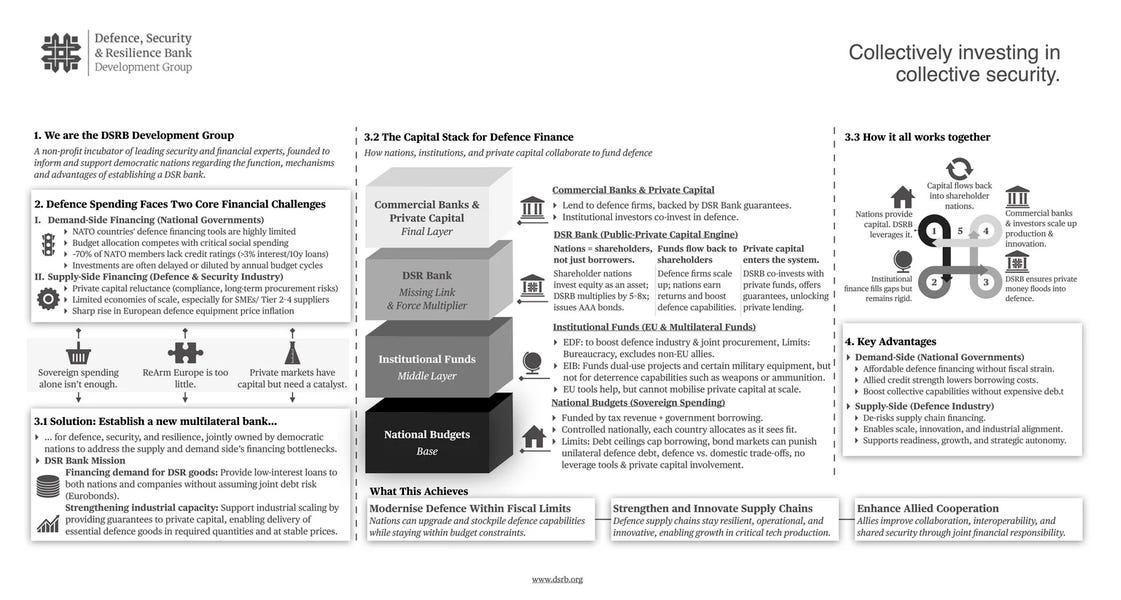
The UK was initially approached to be the leading nation for the DSRB, which would have made sense – the UK is a financial powerhouse with strong links to North America, Europe, and Asia. Not only would the UK’s defence industry have benefited from the DSRB’s core function – providing affordable finance for defence and security purposes – but we would have garnered significant influence and status as the leading nation. Unfortunately, the Treasury didn’t like the idea and wanted to do their own thing. However, the DSRB now has momentum and backing, while the Treasury’s proposed Multilateral Defence Mechanism does not. Hence, Chancellor Rachel Reeves scrambling to suggest a merger between the two after the announcement of the DSRB at Ankara this week.
The DSRB was there for the taking as a win for the UK. Instead, we dithered, did our own thing, and let the opportunity pass.
Weapons for Thee, But Not for Me
Quietly, the UK has managed to mobilise its industry to quickly provide weaponry for Ukraine, often through the clever modification of existing equipment. One of the best examples of this is Raven – a modification of a British air-to-air missile for ground-based use, which was purportedly designed in only a few months in 2022 with deployment starting the following year. As part of Task Force Kindred, the UK MOD has provided weapons through similar projects, and continues to develop equipment specifically for Ukrainian use, most recently Projects Brakestop and Nightfall – attempts to create low-cost cruise and ballistic missiles respectively.
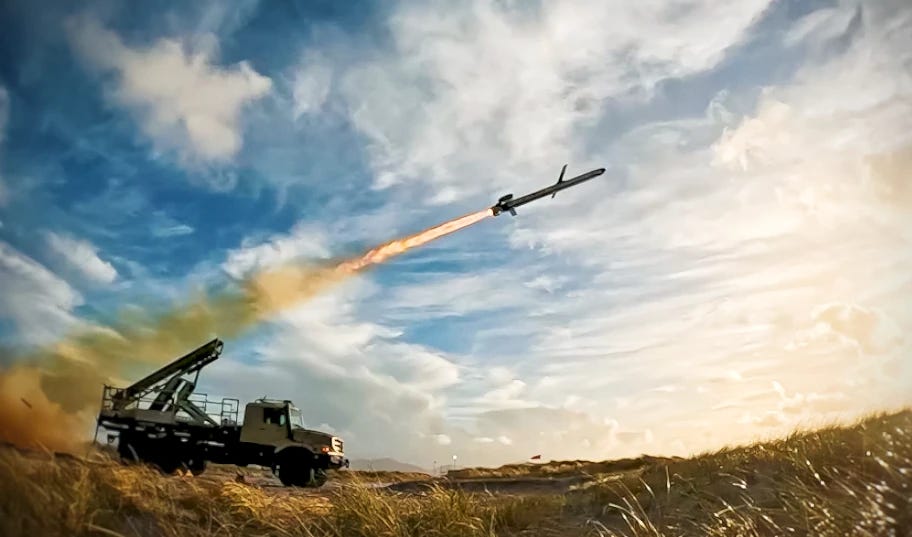
This is a great idea that makes a lot of sense, not least because the UK also needs long-ranged ground-launched missiles to augment its current artillery. However, the MOD has explicitly ruled out the adoption of the Nightfall ballistic missile. This seemed confirmed in the DIP when it was announced that the UK was buying the American PrSM ballistic missile instead. I don’t know about you, but it seems odd that the UK would explicitly not use weapons it was developing in-country and instead rely on alternatives from abroad that were more expensive and from an arguably-unreliable supplier. For a government that can’t go without thirty seconds before ramming the terms ‘growth’ and ‘exports’ down everyone’s throat at every opportunity, it is baffling.
Yes, it is likely that the British Army wanted PrSM because it could be more easily-fired from our existing M270 launcher vehicles – but surely you could stipulate such requirements for Nightfall? Regarding Brakestop – while the news is trending more positively, there has been no official confirmation of adoption, despite the UK continually banging on about needing large numbers of less ‘exquisite’ weaponry. You’d have thought that the DIP would provide clarity, but, alas.
Own Goals Everywhere
The story of the last year has been one of significant own-goals from the UK defence. While we have dithered and floundered, many of our allies in Europe have, broadly, gotten on with it. It is both embarrassing and dangerous. British military personnel, the British public, and our allies all deserve better.
Cracking Defence is a reader-supported publication. If you enjoy my work, please like, share, subscribe, and if you are able, buy me a coffee to support my work. All and any support is hugely appreciated.
This will be the sum total of my football jokes. Probably for the best, as my serious knowledge of the sport is sadly limited…
I’m halfway through another written rant about defence jargon - watch this space…
For context, the Nuclear budget includes anything nuclear-related, not just weapons - so the submarines are all wrapped under this budget as well.
Your last sentence seems to exonerate senior military from this mess. I convinced a big part of the problem is mediocre air marshals admirals and generals
Ouch. That is quite a blistering little analysis - I felt the impact of some of it from 8000 km. One of the many things that is not clear to me is where the money for the DSRB will come from? If national defense budgets are not big enough on their own, how can the various nations find additional funds for the loan pool?